
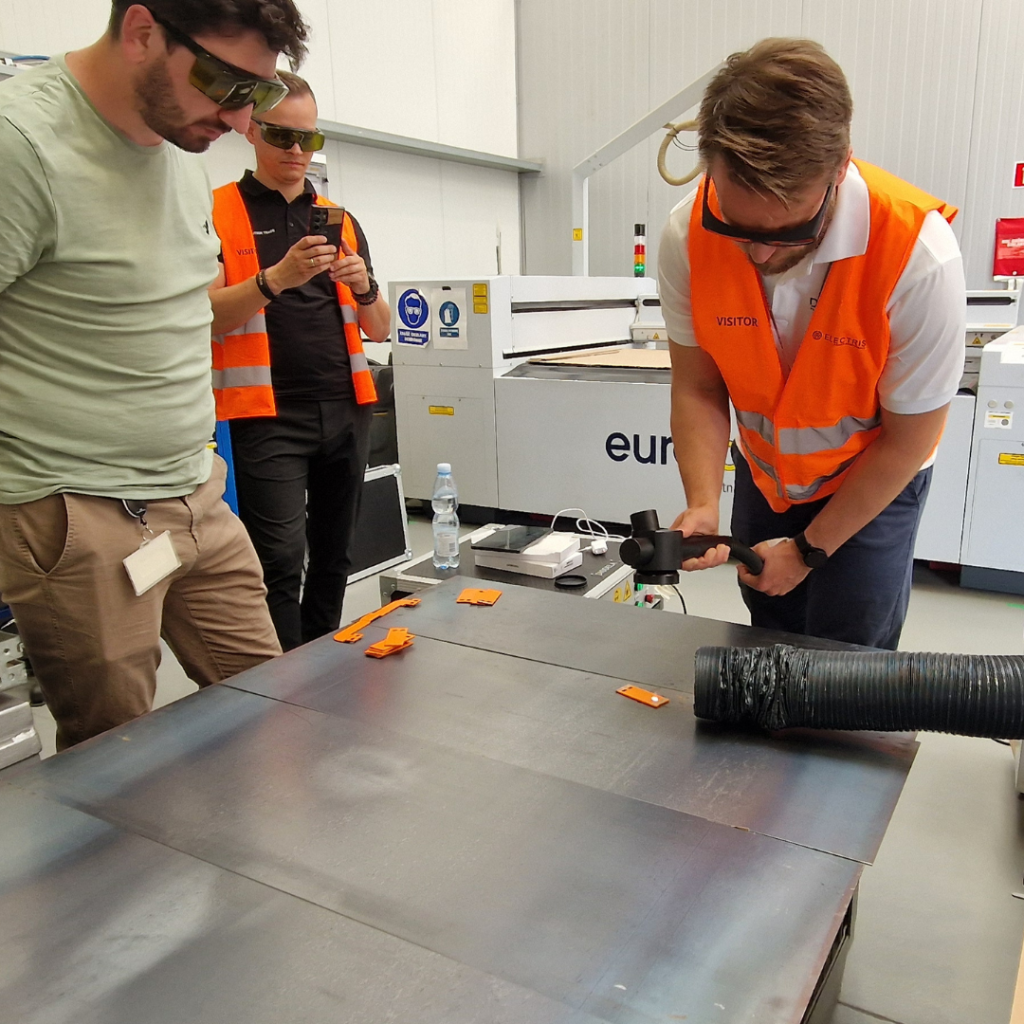
Should a company hire dozens of employees for repetitive tasks, or invest in a single technological solution that delivers speed, quality, and sustainability? In modern industry, this question is more relevant than ever. Skilled labor is increasingly scarce, order volumes continue to grow, and deadlines are tighter than ever before.
Under these conditions, traditional methods (e.g., MIG or TIG welding, chemical surface cleaning) often fail to provide the required productivity or consistent quality. That is why more and more manufacturers are turning to laser technologies – modern solutions that increase efficiency, reduce costs, and ensure sustainable production.
Advantages of Laser Technology in Manufacturing
Laser technologies are becoming a vital part of industrial production thanks to several key advantages:
Speed – processes are carried out several times faster than with traditional methods.
Precision – complex shapes can be processed with micron-level accuracy.
Quality – cleaner surfaces, more aesthetic weld seams, and minimal thermal distortion.
Sustainability – eliminates the need for chemical agents, reduces waste, and makes the process more environmentally friendly.
Automation – lasers can be seamlessly integrated into robotic systems, ensuring consistent results even in mass production.
Taken together, these advantages make laser technologies not just an alternative but a strategic tool that enables companies to maintain a competitive edge.
Real-World Example: The 800,000-Part Challenge
A strong example of laser technology in practice comes from a company specializing in large-scale electrical component manufacturing. The company received a major order – to produce more than 800,000 copper busbars (contact plates). The challenge was twofold: the busbars had to be coated with insulating paint, while the contact areas needed to remain perfectly clean.
At first, the task seemed straightforward, but at scale it revealed serious challenges:
Masking before painting was extremely time-consuming and difficult to manage.
Chemical cleaning required significant manpower, raised environmental concerns, and did not guarantee consistent quality.
Calculations showed that completing the order on time would require hiring more than 20 additional workers just for cleaning. This would have significantly increased costs without ensuring stable quality.
A Hybrid Solution with Diodela
In search of a more effective approach, lasers were tested:
A pulsed laser produced clean results but was too slow.
A continuous wave (CW) laser was fast but left unwanted residues.
Neither method alone met all requirements. The solution was found with the Diocell laser cell developed by Diodela, featuring a hybrid head that combined the advantages of both pulsed and CW modes.
To further optimize efficiency, the process was automated. A collaborative robot (cobot) was installed alongside the cell to handle part loading and unloading. This eliminated monotonous, time-intensive manual work and reduced the risk of errors.
Results
The implemented solution delivered results that far exceeded expectations:
Processing time – less than 1 minute per part.
Quality – completely clean contacts, residue-free, with flawless surfaces.
Labor optimization – no need to hire over 20 additional workers.
Process stability – consistent quality across all 800,000 parts.
Sustainability – elimination of chemical agents, making the process more environmentally friendly.
This case demonstrated that laser technologies can transform not only individual processes but also the entire production approach – shifting from manual labor to fully automated, fast, and reliable solutions.
Looking Ahead
This story is just one of many examples of how laser technologies are solving real industrial challenges. Similar applications are growing rapidly: from improving the reliability of hydraulic cylinder welding to high-precision surface cleaning and microstructure formation.
A common thread connects all these cases: initial doubts about the suitability of new technologies are replaced by clear evidence – through practical testing, measurable results, and an integrated solution model (equipment + training + support).
That is why today, laser technologies are not just innovations but strategic tools that help companies remain competitive in the marketplace.
Building Long-Term Progress
Modern industry can no longer choose between speed and quality – both are essential. Laser technologies make it possible to achieve this balance, and real-world cases prove that even the largest manufacturing challenges can be overcome.
Technological breakthroughs often begin with doubt, but once supported by real evidence, they become the strongest foundation for long-term progress.