
Aluminum is one of the most important structural materials in modern industry. Due to its low weight, high strength, and excellent corrosion resistance, it is widely used in the transportation, construction, and metal fabrication sectors. However, welding aluminum remains a technologically complex process that requires precise parameter control and stable equipment performance.
The complexity of aluminum welding is influenced by several key factors. Firstly, aluminum’s high thermal conductivity makes it difficult to concentrate heat in the weld zone, leading to uneven melting. In addition, the oxide layer on the surface has a higher melting temperature than aluminum itself, which means it must be removed or effectively remelted during the welding process. For these reasons, traditional TIG and MIG welding methods often encounter challenges such as weld porosity and component deformation caused by excessive heat input.
These shortcomings directly affect joint strength, tightness, and surface quality. Furthermore, these methods require highly skilled operators, while productivity remains limited. Consequently, the demand for more advanced technological solutions is increasing.
Laser Welding Trials in Poland
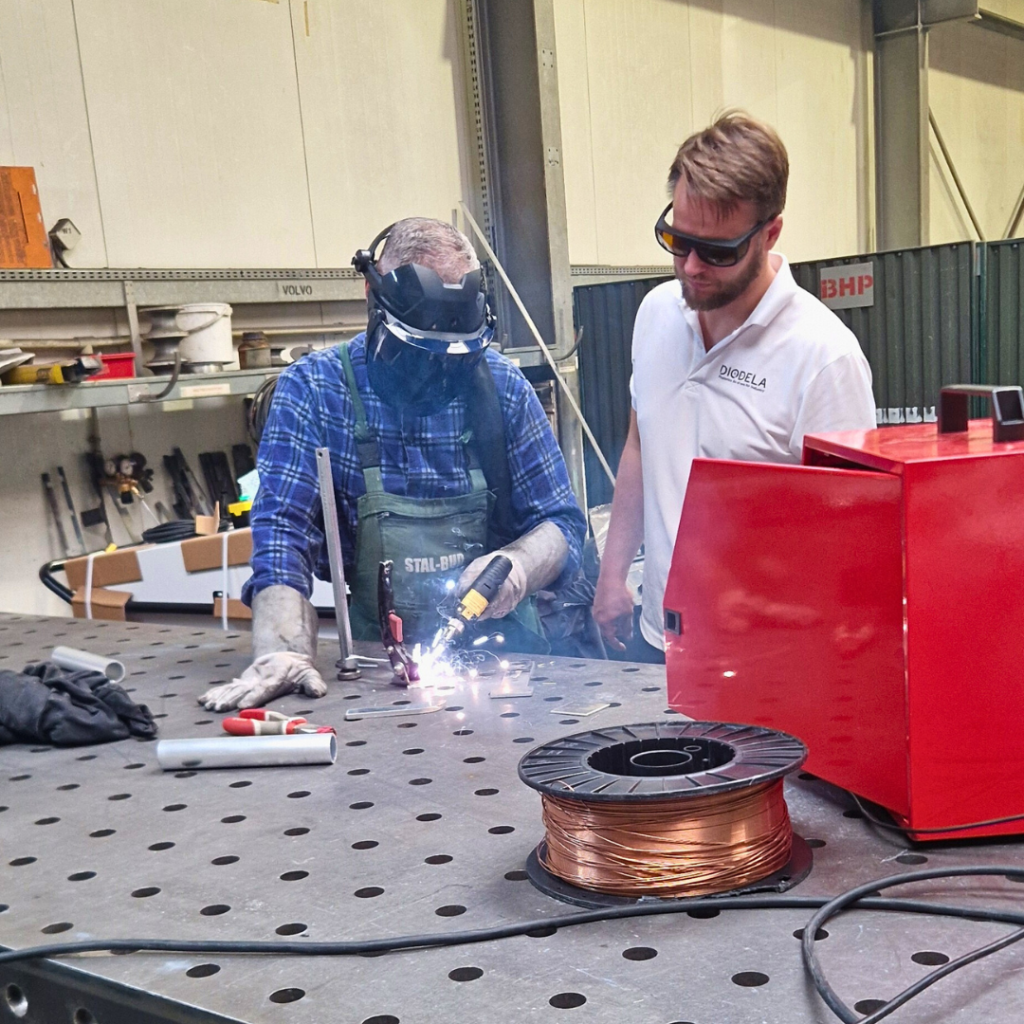
To address the challenges of aluminum welding quality and productivity, the Polish manufacturer StalBUD — specializing in steel structures as well as transport and storage containers — conducted a series of technological trials to evaluate the potential of laser welding. The company has long experience in producing steel and aluminum systems supplied to the automotive and construction industries. In order to maintain high product quality and reduce welding costs, StalBUD decided to test a next-generation laser welding solution developed by Diodela.
Implementation of Diodela Laser Welding Technology
The Diodela engineering team carried out experimental welds using a 2 kW laser welding system designed for joining metal structures and components. During the tests, the stability of the laser process, weld integrity, surface quality, and welding speed were evaluated.
The results demonstrated a clear technological advantage: 6 mm thick aluminum plates were successfully welded at StalBUD without any difficulties. The weld seam was clean, pore-free, and geometrically precise. The laser beam provided a concentrated heat input, minimizing the thermal effect on the metal structure. This eliminated deformation and significantly reduced the need for post-processing.
Results – Higher Efficiency and Reduced Losses
Compared to traditional methods, the welding speed increased by up to five times, while the level of porosity was significantly reduced. The laser welding process ensured excellent repeatability, making it suitable not only for single components but also for serial production.
Another key advantage was stable energy distribution and automatic beam control, ensuring consistent weld quality along the entire seam. As a result, laser welding stands out not only for its speed but also for its high precision — a critical factor when producing airtight or visually exposed joints.
Flexible Cooperation Model
After successful trials, StalBUD, convinced of the reliability of the laser process, decided to continue testing Diodela equipment over a longer period under real production conditions. Based on customer requirements, Diodela proposed a flexible solution: equipment rental with a purchase option.
This model enables companies to practically evaluate the benefits of laser technology, test it in various stages of production, and assess the return on investment before making a final decision on full-scale integration.
Technological Advancement in Practice
Diodela laser technologies not only increase welding efficiency but also allow process automation through integration into robotic production lines. This is particularly important for companies such as StalBUD, aiming to continuously improve product quality, reduce the number of defects, and optimize production costs.
This project confirmed that laser welding is a reliable, precise, and economically viable solution for the aluminum processing industry. By adopting Diodela laser technology, manufacturers can achieve superior welding quality, shorter production cycles, and greater process stability.