
A New Stage in the College’s Scientific and Applied Research
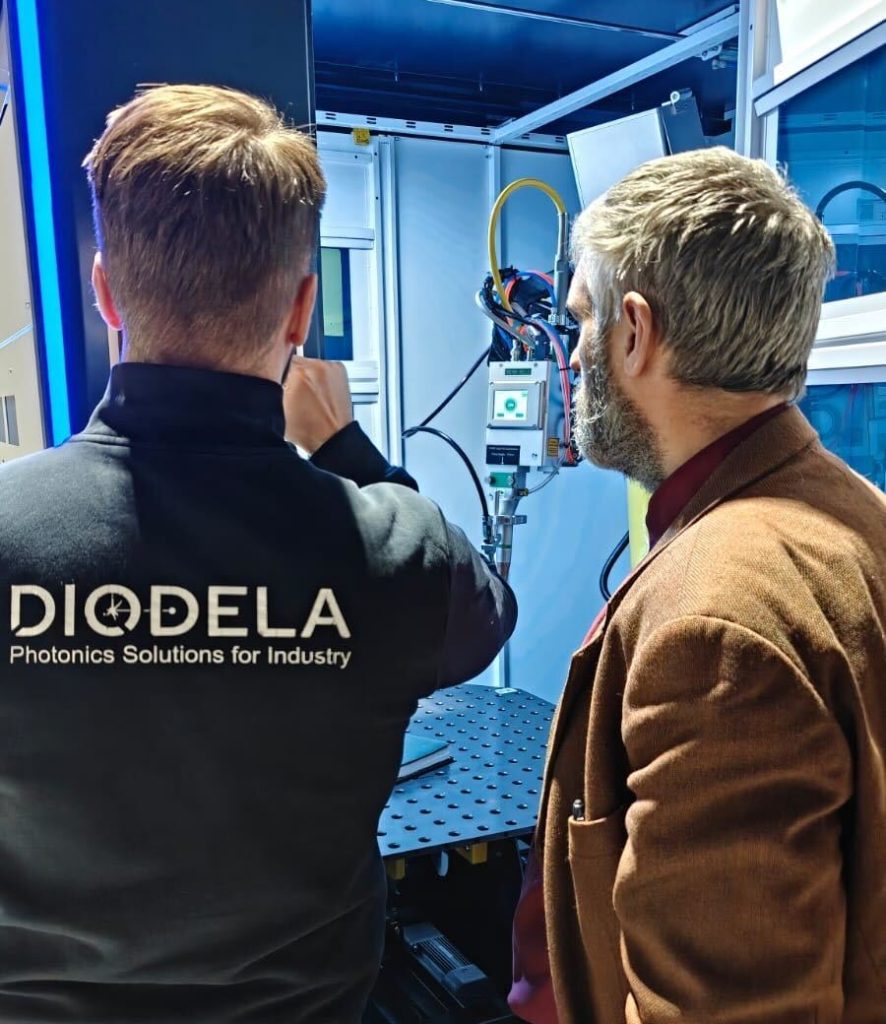
As industrial technologies continue to evolve, Lietuvos inžinerijos kolegija (LIK) has strengthened its research and training environment by acquiring Diocell – a multifunctional laser-process platform developed by Diodela. This investment reflects the college’s commitment to expanding applied engineering research and ensuring that students and researchers have access to equipment used in advanced manufacturing. To support the installation, Diodela engineers conducted dedicated training sessions, enabling the LIK team to gain practical knowledge of the platform and its integration into research workflows.
One Platform – A Wide Range of Laser Technologies
Diocell is designed to support a broad spectrum of laser-based operations, including laser welding, cleaning, cladding, cutting and Laser Metal Deposition (LMD), along with other processes used in modern material engineering.
The platform’s key strength is its modular architecture, which allows multiple laser processes to be carried out within a single laser-safe cell. Technological configurations can be adjusted quickly, making the system suitable for different research scenarios and industrial tasks.
Diocell is compatible with high-power laser sources, industrial robots, mechatronic modules, vision systems and precision measurement equipment, allowing seamless integration into both scientific laboratories and production-oriented environments.
In addition, Diocell supports workflows used in layered surface engineering, such as material deposition, surface restoration and functional surface modification – opening research opportunities that were previously restricted due to equipment limitations.
How LIK Will Use Diocell in Research and Practical Activities
During the training sessions, Diodela engineers introduced the core functions that LIK will apply in its ongoing work:
- Precision laser welding for scientific experiments, structural analysis and development of advanced metal joining methods.
- Laser cleaning for removing oxides, coatings and contaminants while studying surface-preparation efficiency.
- Cladding for restoring worn surfaces and evaluating protective-layer technologies.
- Laser cutting for geometrical analysis, prototype fabrication and material characterization.
- Laser Metal Deposition (LMD) for building 3D layers, restoring material volume and conducting additive-manufacturing research.
- Surface modification for developing micro-structures and engineering functional surfaces.
These applications will enable LIK to support both fundamental material research and practical industry-driven projects.
Digital Twin: A Virtual Environment for Process Development and Optimization
The integrated digital twin allows researchers to simulate processes in a virtual environment, model robot trajectories and prepare complete programs before transferring them to the physical cell. This helps refine process logic, compare technological setups and ensure a precise transition from virtual programming to real-world execution.
Using the digital twin, the college will be able to optimize workflows, reduce material consumption and carry out complex experiments more safely and efficiently.
Broader Opportunities for Industrial Testing and Demonstrations
LIK frequently collaborates with industrial companies seeking to test or demonstrate laser technologies. These requests typically involve welding, cleaning, cladding, material restoration and other laser-based operations. Diocell enables such processes to be performed professionally and reliably – using both real laser technology and virtual simulations that allow processes to be validated and optimized in advance.
The platform strengthens LIK’s ability to develop experimental methodologies, perform tests tailored to industry requirements and showcase advanced laser processes in real time. This enhances the college’s value as a practical innovation partner for the manufacturing sector.
Future Plans and Strengthened Collaboration
LIK specialists have positively evaluated Diocell’s versatility and plan to use the platform extensively in research, experimental development and industrial demonstrations. Diodela will continue to provide technical support and consultation as the college expands its use of advanced laser technologies.
Diocell is becoming a strategic technological asset for Lietuvos inžinerijos kolegija – boosting research capacity, strengthening practical engineering competencies and fostering deeper collaboration with Lithuanian industry.