
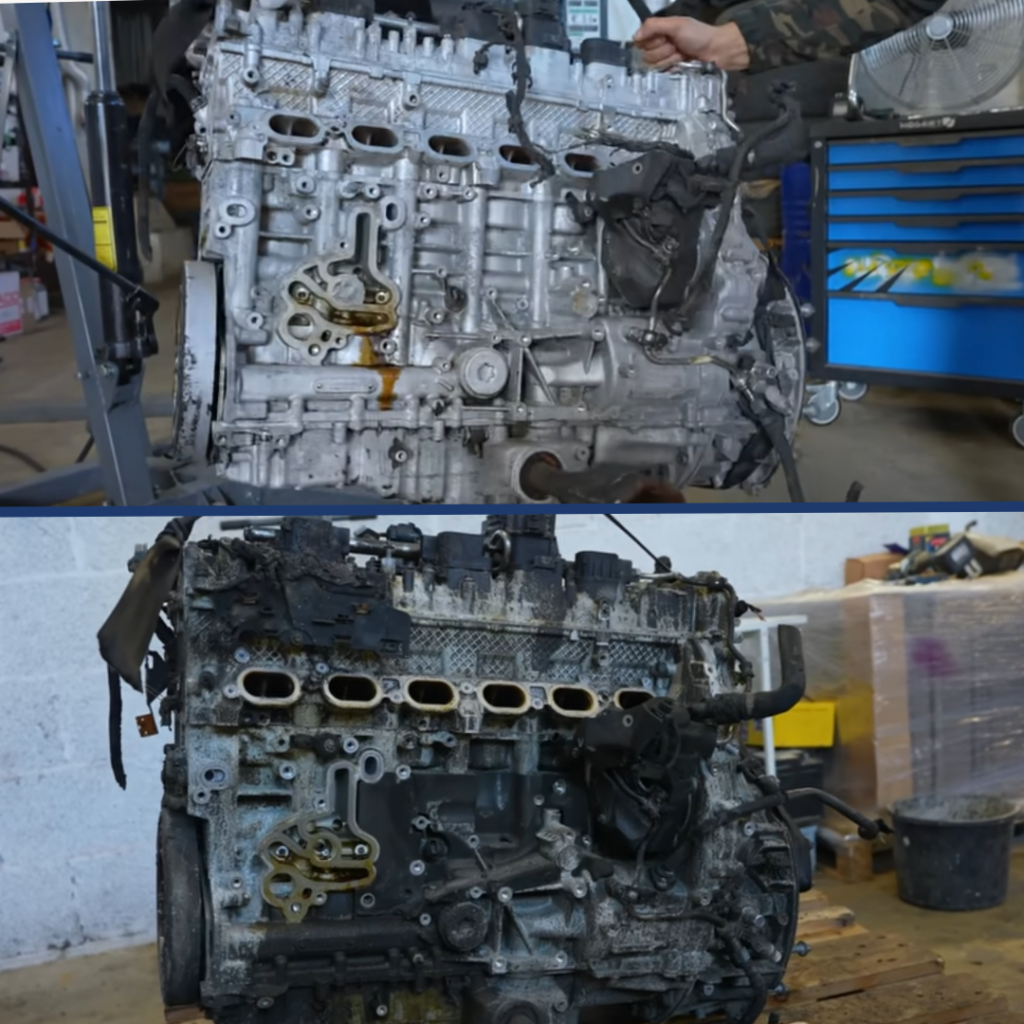
After a vehicle fire, visible damage is often only part of the problem. Soot, burnt residues, oxidation layers, oil deposits, and traces of burnt plastic or rubber can settle on engine components, metal brackets, mounting points, frame elements, housings, and other technical surfaces.
This type of contamination makes it difficult to assess the actual condition of the part. When the surface is covered with fire residues, it becomes harder to identify cracks, corrosion, deformation, or the effects of heat exposure. For this reason, post-fire cleaning is important not only for appearance, but also for preparing the surface for inspection, repair, painting, protective coating, or restoration.
Why Choose Laser Cleaning?
Laser cleaning removes contaminants from metal surfaces without sandblasting, grinding, or chemical cleaning. This is especially important after a fire, when surfaces are often unevenly contaminated and each component must be assessed as accurately as possible.
With properly selected laser cleaning parameters, only the unwanted surface layer is removed while the base material remains protected. This is particularly important when cleaning complex-shaped parts, mounting points, edges, corners, recesses, and hard-to-reach areas, where more aggressive cleaning methods may leave marks or affect the geometry of the component.
A cleaned surface allows specialists to clearly see the actual condition of the metal and make informed decisions: whether the part can continue to be used, or whether it needs to be repaired, restored, repainted, coated with a protective layer, or replaced.
Advantages of the Diodela Laser Cleaning System
Diodela laser cleaning systems are well suited for cleaning engine parts, metal components, and other vehicle surfaces after fire damage. The technology provides greater process control, helps reduce the risk of additional damage, and enables clean, precise, and consistent surface preparation.
⚙ Non-abrasive cleaning without chemicals – laser cleaning is a contactless process that does not require mechanical abrasives, sandblasting, grinding, or chemical cleaners. This helps preserve the surface, shape, and dimensions of the cleaned part.
⚙ High precision in complex areas – the laser beam can be directed at a specific area, making it convenient to clean mounting points, edges, corners, recesses, and hard-to-reach surfaces without affecting adjacent areas.
⚙ Adjustable and savable cleaning parameters – cleaning settings can be adapted according to the surface type, level of contamination, and cleaning objective. Saved parameters help maintain consistent results during repetitive tasks.
⚙ Compact and portable system – Diodela laser cleaning systems are compact, mobile, and easy to move between work areas, making them suitable for different maintenance, repair, and restoration environments.
⚙ User-friendly operation – the lightweight laser gun, red laser pointer, and integrated touchscreen interface help ensure comfortable and precise process control.
⚙ Fast preparation for work – the system can be prepared for operation quickly, reducing setup time and allowing more time to be spent on the cleaning process itself.
⚙ Additional safety features – Diodela systems include additional safety functions such as a door sensor, wireless control, and a two-step launch feature, helping ensure safer and more stable operation.
⚙ Cleaner working environment – because no chemical or abrasive materials are required, the process produces less waste and reduces the need for additional post-cleaning work.
Laser Cleaning for More Accurate Part Restoration
After a fire, choosing the wrong cleaning method can damage a part that could still be suitable for further use. An insufficiently cleaned surface may hide important defects, while overly aggressive cleaning can affect the metal surface or the geometry of the component.
Laser cleaning helps reduce these risks. It allows contamination to be removed precisely and in a controlled manner, enabling specialists to better assess the condition of the part before making decisions about repair, restoration, repainting, protective coating, or replacement.