
Challenge: Continuous Rolling Stock Maintenance
Lietuvos Geležinkeliai is the country’s largest transport group, responsible for operating and maintaining the national railway infrastructure, providing passenger and freight services, and performing rolling stock repair and maintenance. Daily operations involve thousands of wagons and locomotives, whose technical condition directly impacts both transport safety and service quality.
One of the recurring challenges is rolling stock cleanliness. During service, wagon and locomotive components become covered with dirt, rust, oil deposits, and deteriorated paint layers. Traditional cleaning methods—such as sandblasting and chemical washing—are slow, expensive, labor-intensive, and generate significant amounts of waste. To overcome these limitations, Lietuvos Geležinkeliai partnered with the technology company Diodela to implement a solution that ensures cleaner, faster, and more sustainable maintenance processes.
Solution: Laser Cleaning
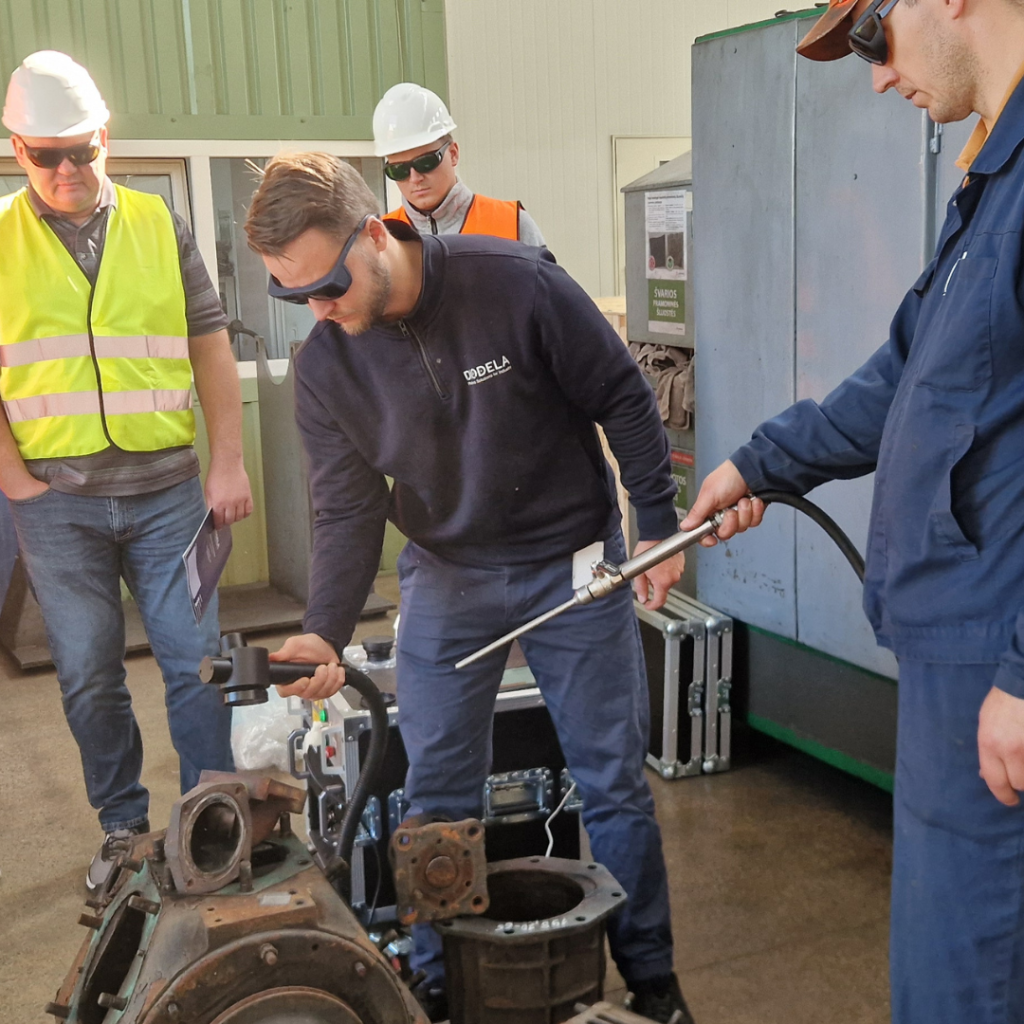
Several years ago, Lietuvos Geležinkeliai implemented a robotized laser cleaning system for wagon wheels. After this solution proved effective, the company invited Diodela to demonstrate how laser cleaning technology could also be applied to other wagon and locomotive components.
Upon arrival at the railway facilities, Diodela specialists:
Confirmed that the workplace was safe for laser operations,
Introduced personnel to the main safety requirements,
Installed the equipment and carried out a live demonstration.
Two laser cleaning methods were tested:
Pulsed laser – ideal for precision, layered cleaning. It enables selective removal of dirt while leaving paint intact, or stripping paint without damaging the underlying metal. This is particularly valuable when surface protection and structural integrity must be preserved.
Continuous Wave (CW) laser – best suited for large components contaminated with heavy rust, oil, or other residues. This method achieves an impressive cleaning speed of up to 10 m² per hour.
Results and Benefits
The demonstration confirmed that laser cleaning:
Precisely removes contaminants without damaging the metal surface,
Enables fast and efficient cleaning,
Requires no additional consumables (such as abrasives or chemicals),
Is environmentally friendly and leaves no waste,
Requires only basic operator training rather than advanced qualifications.
This approach not only reduces time and operational costs but also extends the service life of rolling stock, minimizes waste, and improves working conditions.
Conclusion
Laser cleaning represents an innovative and sustainable alternative to outdated methods in the railway industry. The collaboration between Diodela and Lietuvos Geležinkeliai has proven the technology to be reliable, efficient, and environmentally friendly. It ensures that the national train fleet is maintained to the highest standards—modern, sustainable, and ready to safely transport both passengers and freight.