
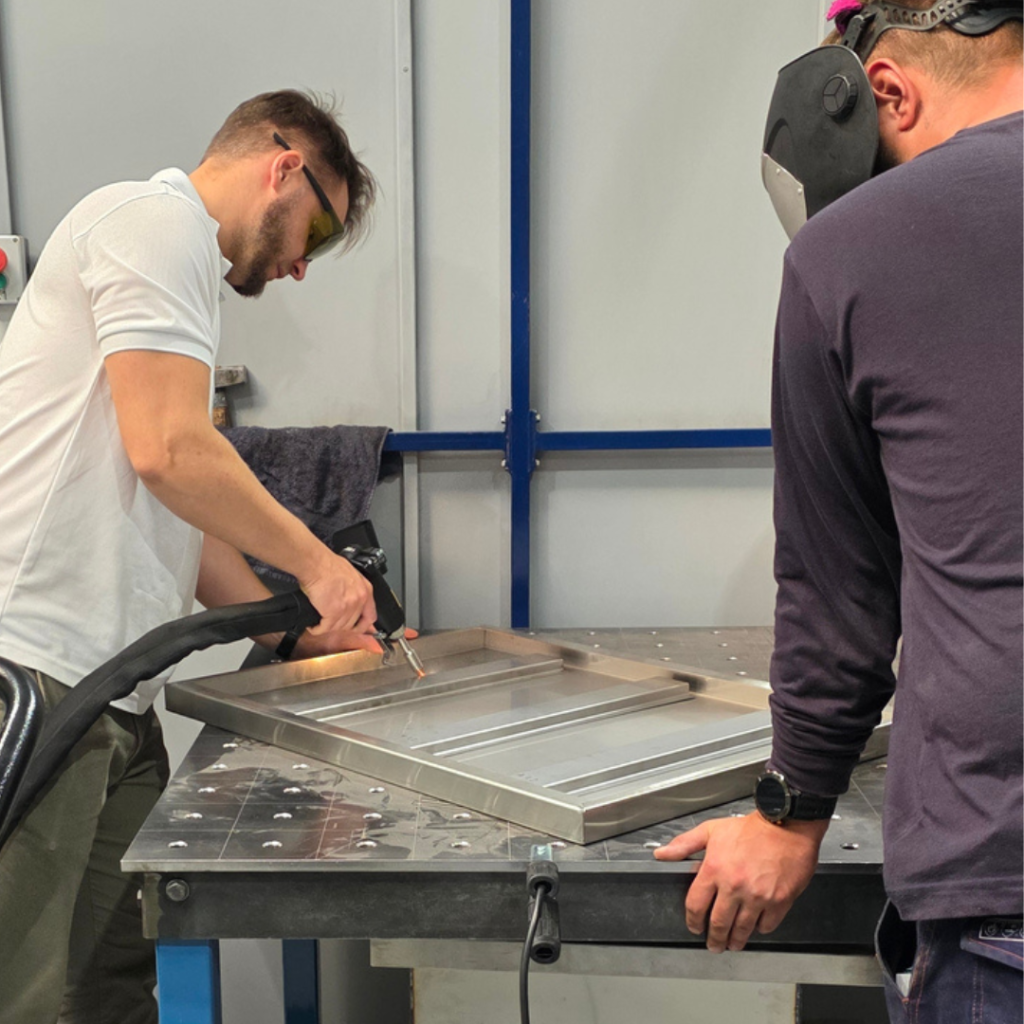
Stalgast, a Polish manufacturer of professional catering equipment and stainless steel furniture, was looking for a faster way to attach supports beneath its worktops. Until then, the supports had been secured using industrial adhesive, which delivered the required clean finish but needed several hours to cure, delaying subsequent production stages.
The Diodela team’s objective was to develop a faster solution that would maintain a strong, reliable joint without leaving any marks on the visible surface of the worktop.
The project also marks another successful sale of Diodela equipment in Poland, completed in cooperation with our Polish distributor, Solution Trade.
The technical challenge
The supports are attached to the underside of the worktop, while its upper surface must remain completely clean and flawless, with no visible weld marks, deformation or discolouration.
The task was made more challenging by the combined thickness of the support and worktop, which was just 1.6 mm. In addition, the high-grade stainless steel used in production is sensitive to excessive heat, meaning that even slight overheating can cause visible discolouration.
A precisely controlled welding process was therefore required to create a strong joint without damaging the thin stainless steel.
A precisely controlled laser welding solution
After assessing the product design, material and surface-quality requirements, the Diodela team proposed replacing the industrial adhesive with laser spot welding.
During practical trials, our engineers carefully fine-tuned the welding parameters. Precise control of the heat input and welding time allowed the supports to be welded securely without overheating the worktop. As a result, its visible surface remained free from weld marks and discolouration.
From hours to minutes
Laser spot welding eliminated the lengthy adhesive-curing stage. Several hours of curing were replaced by a welding
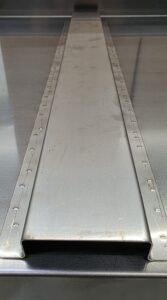 operation taking just a few minutes, allowing the product to move to the next production stage much sooner.
The key results:
- a strong and reliable joint;
- a clean and flawless visible surface;
- no heat-related discolouration;
- a significant reduction in fastening time.
This accelerated the production process without compromising either the strength of the joint or the quality of the finished product.
Moving towards robotic automation
The welding parameters established during the trials provide the foundation for the next stage of the project: automated support fastening. Once this operation is robotised, it will be possible to further increase productivity, ensure consistent results and apply the solution in series production.
The Stalgast project demonstrates how replacing a time-consuming operation with the right laser technology can significantly accelerate production and pave the way for further automation.