
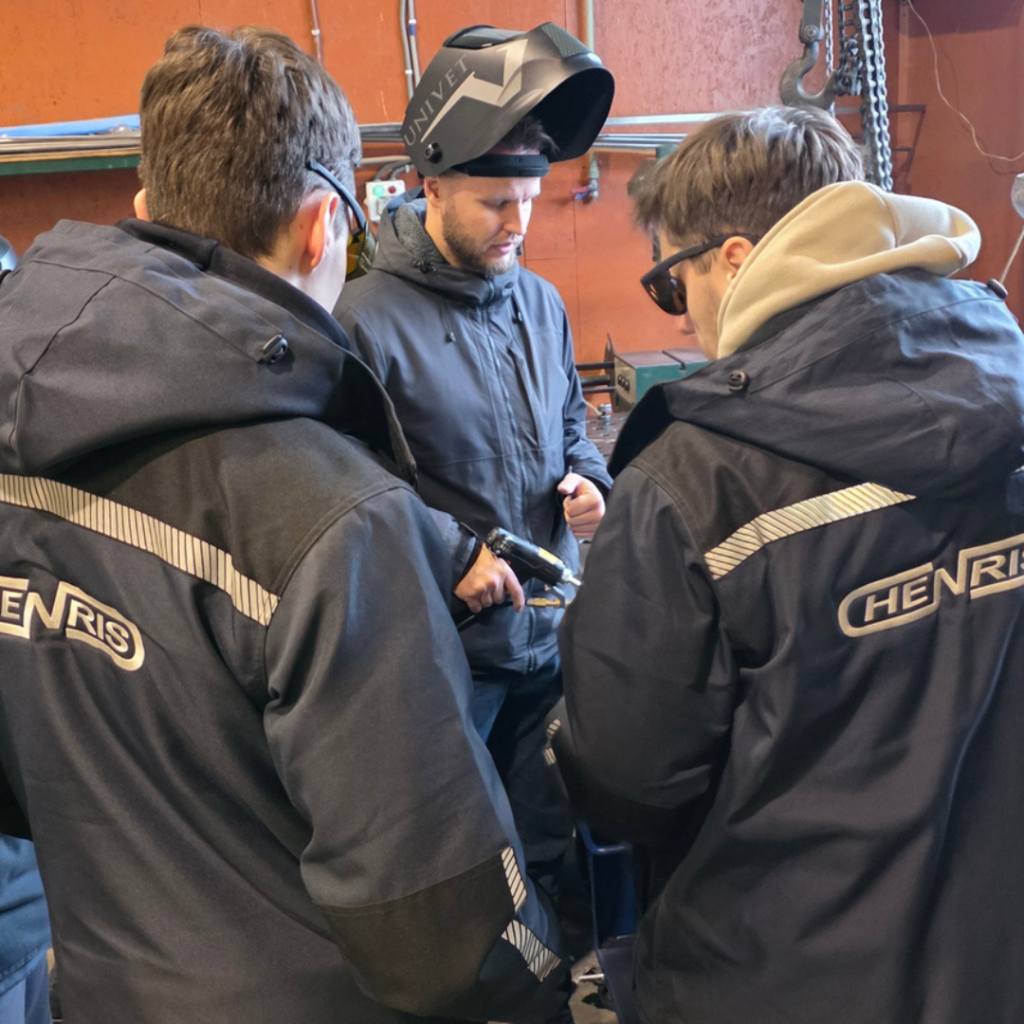
In manufacturing companies, welding often becomes a critical process that expands technological capabilities and shortens project lead times. However, not all companies have their own welding capacity from the beginning, so part of the work is often outsourced to external partners.
A similar situation existed for UAB Henris, a company operating in tube processing and tubular structure manufacturing since 1993. Over more than three decades, the company has built extensive experience and a highly skilled team capable of delivering a wide range of industrial projects. However, one process remained a challenge for a long time – welding.
The Challenge: Dependence on External Welding Services
For many years, more complex welding tasks were outsourced to external welding service providers. While this approach allowed projects to be completed, it also had its drawbacks.
First, it extended production lead times, as welding work had to be scheduled according to the availability of external contractors. In addition, it reduced flexibility in project planning and left part of the manufacturing process outside the company’s direct control.
As a result, the question increasingly arose within the company: would it make sense to bring welding operations in-house?
The Solution: Laser Welding
The situation changed after a visit to Diodela. After evaluating the capabilities of the technology, the Technical Director of UAB Henris decided to implement a laser welding solution.
The goal was clear – to bring welding operations in-house, reduce production lead times, and increase flexibility within the manufacturing process.
Laser welding proved to be an attractive solution not only because of its technological advantages, but also because the process is easier to master than traditional MIG or TIG welding methods.
Why Is Laser Welding Easier to Master?
Traditional welding methods often require a long training period—sometimes six months or more—before a welder gains enough experience to work consistently and produce high-quality welds.
Laser welding, on the other hand, allows operators to learn the process much faster. In many cases, operators are able to start producing quality welds after approximately two weeks.
This is possible due to several technological advantages:
- No complex hand movement techniques are required – unlike traditional MIG or TIG welding processes, operators do not need extensive practice to master precise hand stability and coordination. This allows them to learn the process faster and reduces the risk of errors.
- No need to maintain a precise distance between the metal and the torch – in MIG and TIG welding this distance is critical, as too small a gap can damage the electrode or destabilize the arc. In laser welding, this requirement is significantly less critical, making the process easier for the operator.
- No need to move the torch in multiple directions simultaneously – traditional welding often requires coordinated multi-directional movements to form the weld seam properly. With laser welding, it is often sufficient to select the appropriate filler wire diameter to fill the gap, while the process itself remains much more stable.
- A galvanometric scanner and pre-set wire feed stabilize the welding process – key parameters can be configured in advance, so operators do not need to constantly control welding speed or movements manually. This results in a more consistent weld and higher process repeatability.
For these reasons, the technology is particularly suitable for companies that are just starting to build their internal welding capabilities.
Not Just Equipment – Knowledge as Well
It is important to emphasize that the solution includes more than just equipment. Along with the system, customers receive both theoretical and practical training directly at their production facilities.
This allows operators to start working with the new technology quickly under real manufacturing conditions. In addition, customers receive continuous technical support and consultation.
A Step Toward More Efficient Manufacturing
Bringing welding operations in-house allows companies to gain better control over their manufacturing processes, respond faster to project changes, and reduce dependence on external service providers.
For this reason, laser welding is increasingly becoming a preferred solution for companies looking to modernize their production and improve efficiency.
We would like to thank the entire UAB Henris team for their trust and collaboration. We believe this technological step will become an important part of the company’s continued growth.