
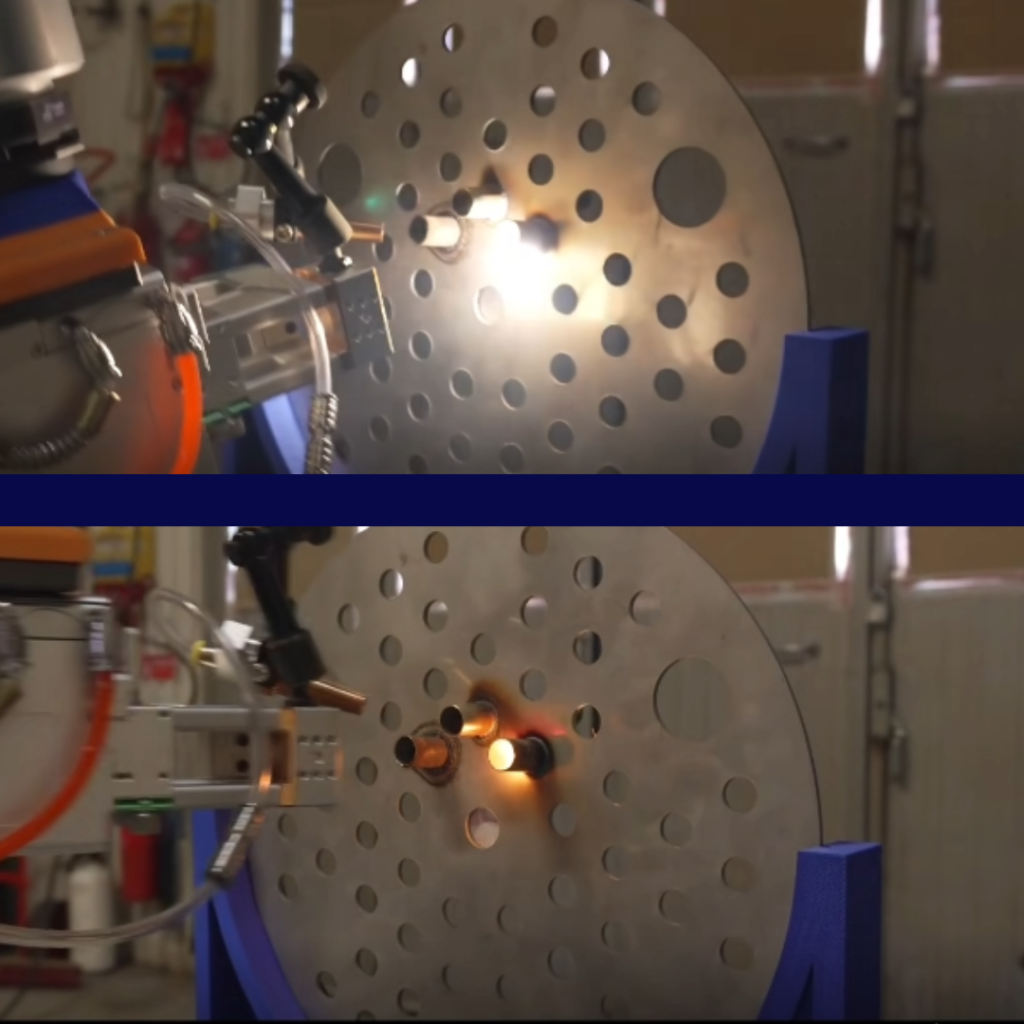
In modern industry, increasing attention is being given to technologies that make manufacturing processes more precise, stable, and easier to automate. One such technology is robotic laser welding, which combines advanced laser technology with robotic automation. This solution enables highly accurate welding of complex components while maintaining a stable process and ensuring consistent results throughout the entire production cycle.
In the current project, a robotic solution is being developed in which a thin-walled pipe is precisely welded to a flange using a Diodela laser power source integrated with a Universal Robots robotic arm. The project is being implemented in collaboration with SE Automation and Svenska Elektrod AB, which are developing a robotic laser welding system for a specific customer application.
Projects like this demonstrate how laser technologies can be successfully integrated into automated manufacturing processes and applied in real industrial environments.
Contact-Free Welding Process
One of the key advantages of laser welding is that the process is contact-free. The laser beam concentrates energy in a very narrow welding zone, melting the metal only where it is required. As a result, the heat impact on the surrounding material remains minimal, helping to maintain the stability and geometry of the component.
The main advantages of this process include:
a narrow and highly precise weld seam
minimal heat impact on the surrounding material
reduced risk of deformation and material stress
a stable and easily repeatable welding process
suitability for thin-walled and sensitive components
Because of these characteristics, laser welding is often chosen for applications where high precision and a clean weld seam are essential.
Integration of Robotics
When laser welding is integrated with robotic systems, the process becomes even more stable and efficient. A robotic arm enables precise control of the laser position and movement, allowing the welding trajectory to be managed with exceptional accuracy.
Robotic systems in manufacturing make it possible to:
automate complex welding processes
ensure high repeatability in serial production
reduce the risk of human error
achieve a more stable and predictable production result
easily integrate the technology into automated production lines
The Direction of Modern Industry
The integration of laser technologies and robotics is becoming an increasingly important part of modern manufacturing and Industry 4.0. Such solutions enable the creation of more efficient, flexible, and easily automated production systems. They help companies increase productivity, maintain high quality standards, stabilize processes, and adapt manufacturing more easily to different products.
This project also highlights the importance of collaboration between specialists from different technological fields. By combining expertise in laser technology, automation, and welding, it is possible to develop solutions that allow industry to operate with greater precision, efficiency, and reliability.
Robotic laser welding is increasingly becoming a practical solution in modern manufacturing, helping companies build more efficient, precise, and competitive industrial production.