
A rapidly growing sheet metal processing company has strengthened its position in the market by consistently investing in quality, advanced technologies, and production efficiency. A modern equipment base combined with a strong focus on customer needs has enabled the company to take on increasingly complex orders – where standard solutions are no longer enough.
As production volumes increased, new challenges emerged. One of them was a large-scale order for manufacturing boxes from 1 mm thick black steel, where not only functionality but also visual quality played a critical role.
Challenge: High aesthetics without compromising efficiency
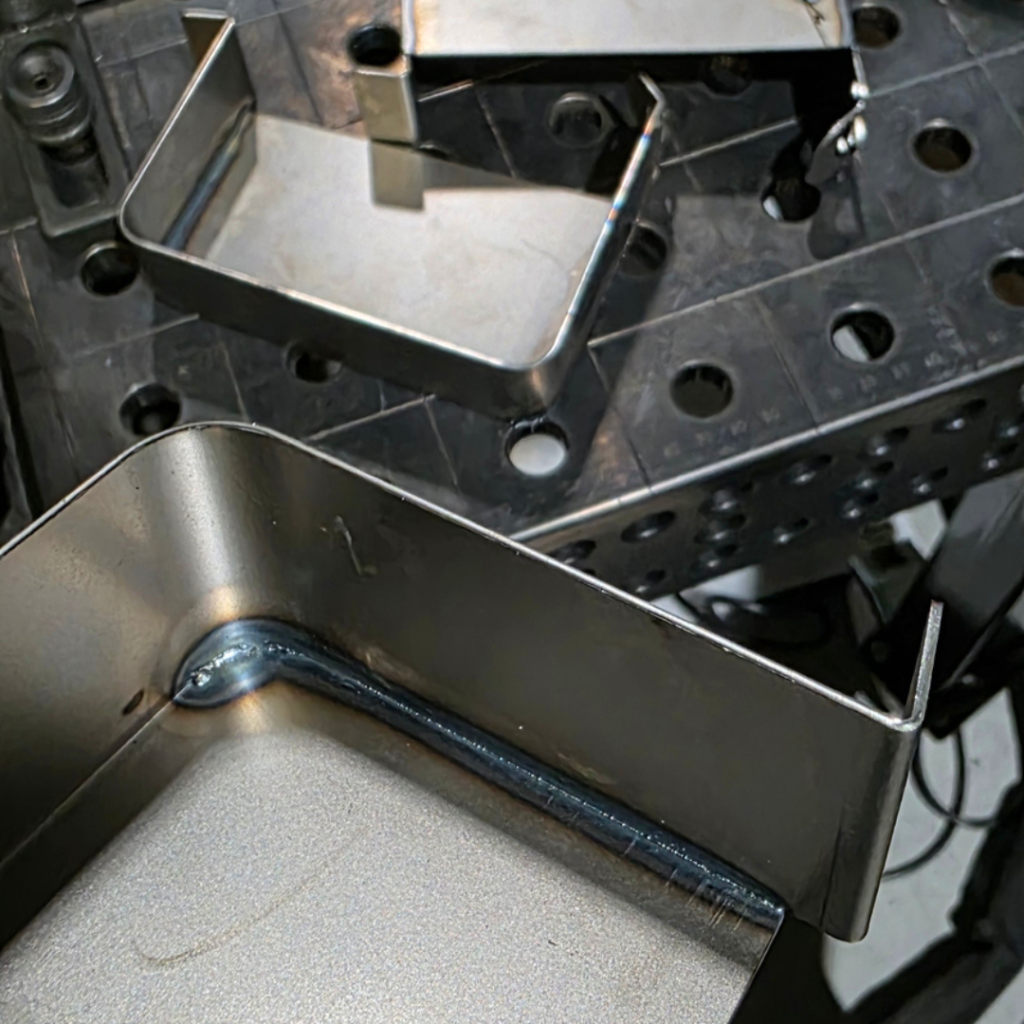
The primary objective of the order was to achieve impeccable weld quality. The weld seam on the inside had to be nearly invisible, while the exterior needed to remain smooth, clean, and visually flawless—without any additional grinding or finishing marks.
Such requirements are particularly demanding when working with thin materials. Even minimal heat input can lead to deformation, while post-processing significantly slows down production and increases costs.
Limitations of traditional methods
After evaluating conventional welding techniques, it became clear that they were not suitable for this application:
- MIG welding would require extensive post-weld finishing, increasing both time and cost
• TIG welding, although precise, is too slow and labor-intensive for high-volume production
It became clear that achieving the required balance between aesthetics, speed, and process stability would require a more advanced technological approach.
Solution: Laser welding and process optimization
Based on our previous collaboration, we were invited to contribute to solving this challenge.
We proposed implementing Diodela laser welding technology and testing it under real production conditions. Together with the client, we carried out trials on the actual product, carefully selected optimal welding parameters, and developed a stable, repeatable process tailored to the specific application.
The entire solution was built through close collaboration—combining practical testing with process optimization to ensure reliable, production-ready results.
Benefits of laser welding in practice
The impact of laser welding was immediately visible. The weld seam became clean, precise, and aesthetically refined, with little to no need for additional finishing. At the same time, welding speed increased significantly, while the reduced heat input minimized the risk of deformation in thin materials.
Equally important, the process became highly stable and repeatable—an essential factor for efficient serial production.
A flexible approach to equipment investment
Following successful testing, the next step was equipment implementation. To support the client, we offered a flexible acquisition model, allowing the investment to be spread over several months.
This approach reduced the financial burden, enabled faster adoption of the technology, and ensured smoother budget management.
Results: More than just a completed order
The outcome extended far beyond fulfilling a single order. The production process was significantly improved – reducing secondary operations, shortening production time, and increasing overall efficiency.
At the same time, product quality improved, and the company gained greater flexibility to take on more demanding and higher-value projects in the future.
When technology creates value, not just solves problems
This case clearly demonstrates that advanced technologies are not just tools for solving immediate challenges – they are strategic drivers of growth.
By integrating laser welding into the production process, we helped transform not only how this order was executed, but also how future opportunities can be approached—with greater efficiency, quality, and competitiveness.