
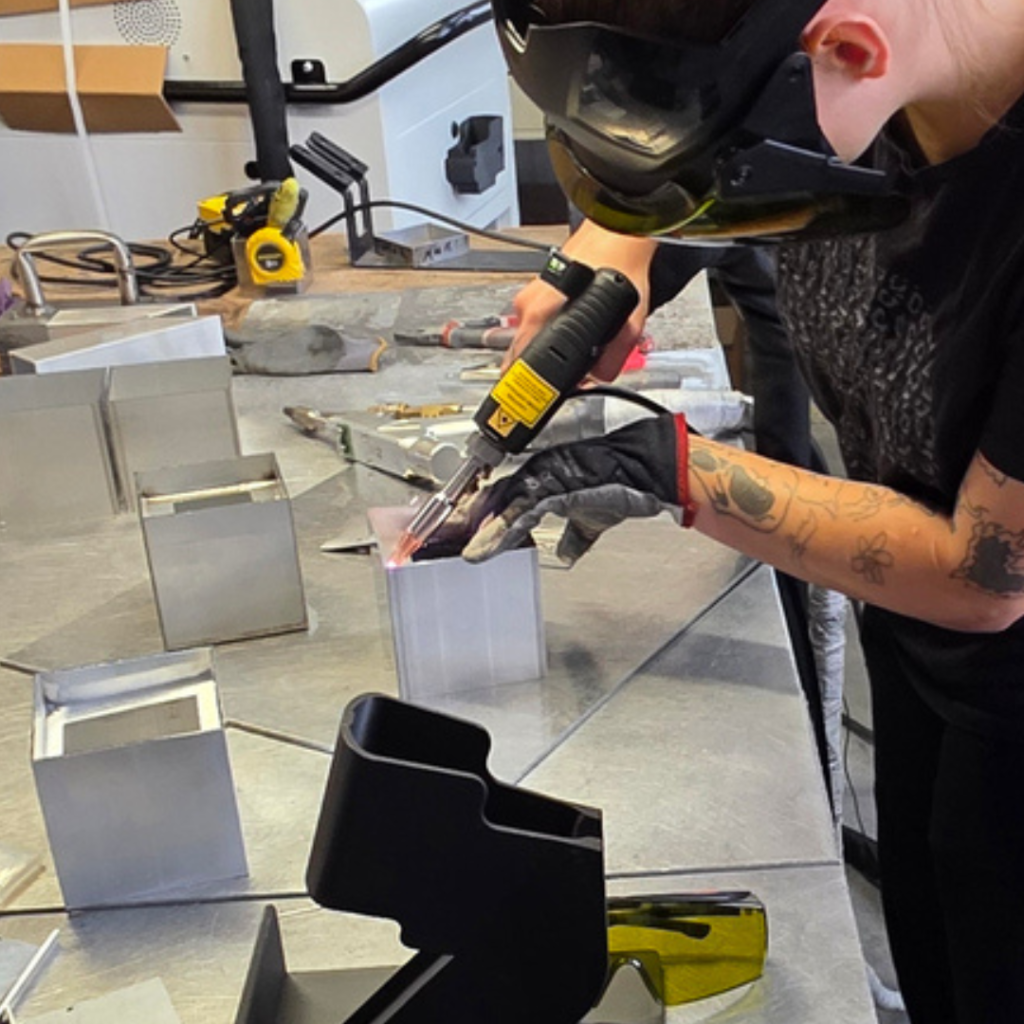
Aluminium is one of the most widely used materials in modern lighting production. Due to its low weight, corrosion resistance and attractive appearance, it is well suited for manufacturing modern luminaire housings and structural components. However, aluminium is also a technologically demanding material to weld, especially when high standards are required for weld precision, cleanliness and visual quality.
These challenges are highly relevant to PXF Lighting, a manufacturer of luminaires and lighting systems with a strong position in the European market. The company specialises in technologically and structurally advanced lighting solutions, where precision, process stability and reliable results are essential in production.
Why Is Aluminium Difficult to Weld?
One of the main challenges in aluminium welding is the oxide layer that forms on its surface. Aluminium oxide melts at approximately 2050 °C, while aluminium itself melts at around 660 °C. Because of this difference, the oxide layer makes proper weld penetration more difficult. In TIG welding, an AC function is required to help remove the oxide from the surface.
Another important factor is aluminium’s high thermal conductivity. The material dissipates heat very quickly, making it harder to control the weld pool, maintain stable penetration and avoid deformation. This is especially important when welding thin luminaire housing components, where even slight overheating can affect the shape or appearance of the final product.
In MIG welding, additional difficulties are caused by the softness of aluminium wire. It can jam, deform or create “bird nesting” in the wire feeding system, which requires special U-groove rollers, Teflon liners and precise equipment adjustment. Aluminium is also highly sensitive to surface cleanliness – moisture, oils or unremoved oxide can lead to porosity and poor weld quality.
In lighting production, these factors are particularly important because a strong joint alone is not enough. The weld must also be visually clean, and the component must retain its geometry after welding. Therefore, the choice of welding technology has a direct impact on the quality of the final product.
The Solution – Diodela Laser Welding System
To address the challenges of aluminium welding more effectively, PXF Lighting acquired a Diodela laser welding solution. The system was selected as a practical alternative to traditional MIG and TIG methods, enabling more precise process control, reduced deformation and higher weld quality.
This technology helps solve the key challenges of aluminium welding: it reduces deformation, improves heat control, lowers the risk of weld porosity and ensures a more stable production process.
The Diodela laser welding solution provided PXF Lighting with the following key advantages:
- Lower heat impact on the component – the laser beam concentrates energy in a narrow area, reducing excess heat input into the aluminium.
- Reduced risk of deformation – this is especially important for thin luminaire housing components that must maintain their precise shape and aesthetic appearance.
- More precise and visually cleaner welds – laser-welded seams are narrow, smooth and clean, making them better suited for visible metal components.
- Less post-processing required – cleaner welds reduce the need for grinding or other corrective work after welding.
- Higher production efficiency – laser welding is fast, stable and well suited for serial production, where consistent results are essential.
- Lower risk of contamination and tool wear – the laser head does not physically touch the workpiece, making the process cleaner and less dependent on the wear of contact parts.
- Easier employee training – the PXF Lighting example shows that even less experienced employees can achieve good results more quickly with laser welding technology.
From a Complex Manual Process to a Controlled Technology
By implementing the Diodela laser welding solution, PXF Lighting made aluminium welding more predictable and easier to standardise. This is important not only for weld quality, but also for the entire production workflow: stable results make it easier to plan work, meet deadlines and maintain a consistent product standard.
This case also reflects a broader trend in industry: modern technologies help reduce dependence on highly complex manual skills. Welder experience remains important, but the laser process provides greater control and enables new employees to integrate into production more quickly.
The PXF Lighting example shows that laser welding is not simply a replacement for existing equipment. It is a strategic investment in a more modern, flexible and reliable production process – especially when working with a demanding material such as aluminium.